Wrangling the Data Center Boom
UT geoscientists are helping Texas understand the impact of the data center explosion
By Anton Caputo
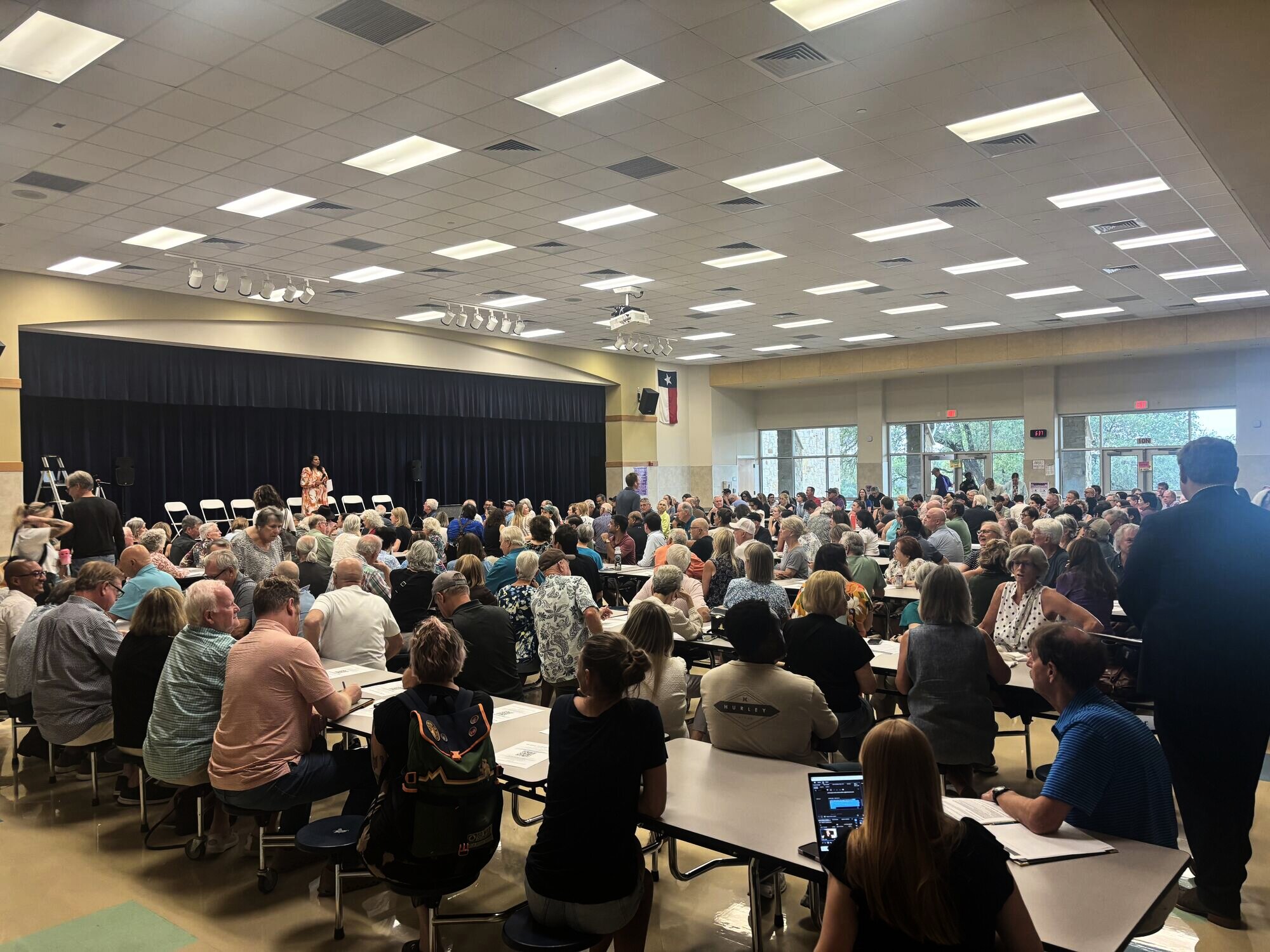
Austin residents concerned about a potential data center development at the former 3M campus gather on Sept. 17, 2026, for a community meeting. Photo: Jackson School.
Texas is facing a rush of proposed data centers, the massive computing facilities that are feeding the boom in artificial intelligence. Their potential electricity needs dwarf the state’s existing demand. Yet one of the most pressing questions is how much of that growth will actually happen — and where.
In August, the governor’s office reported that requests to connect to the Electric Reliability Council of Texas (ERCOT) grid exceeded 474 gigawatts — more than five times the grid’s record peak electricity demand. Data centers accounted for approximately 90% of new power requests.
The number is impossible to meet, and most people agree that much of it is a “phantom load” prompted by data center developers shopping for the best deal but unlikely to pull the trigger on most of the proposals.
For communities trying to understand what is coming, the distinction between a proposal and a project that will actually be built matters enormously. Decisions about water supplies, electricity infrastructure and neighboring properties depend on knowing which developments are likely to move forward and what they will require.
“I’ve never seen an issue rise to this level this fast and this large,” said Rick Thompson, legislative director of the County Judges and Commissioners Association of Texas. “You can’t go to a commissioners court meeting hardly anywhere in Texas now where there’s not standing room only.”
The uncertainty has prompted state intervention. In August, Gov. Greg Abbott ordered an audit of data centers seeking connection to the ERCOT grid. A month later, he directed the Texas Commission on Environmental Quality to halt permits sought by data centers until ERCOT could complete its audit.
Abbott said that state agencies need more information to evaluate the projects’ effects on electricity and water supplies. The state’s audit also seeks more detailed information from developers that can help answer pressing questions such as: What is the expected annual and peak electricity demand? How much water will be consumed and where is it coming from? What cooling technology are data centers using? And what will the quality-of-life impacts be in neighboring communities?
At the Jackson School of Geosciences, researchers are conducting their own studies that can help regulators and communities get closer to answers.
The research is led by COMPASS, a research consortium at the Bureau of Economic Geology that was founded in 2025 to examine big questions associated with data centers and other large-load developments.
Led by bureau Chief Economist Ning Lin, researchers at COMPASS study how electricity, water, land use and technology shape data center development. Their goal is to give communities, regulators and companies a clearer basis for evaluating proposed projects.
“The interconnection number is the tip of the iceberg,” she said. “Beyond the application, there is little public information on these projects, including how they align with local water, land and neighboring communities, and that is the challenge for agencies and decision-makers. Not every project in the queue will be built, and it is hard to tell which ones, and where. That is the concrete question: How will development intersect with local resources and energy?”
COMPASS stands for Collaborative Optimization & Management of Power Allocation: Surface & Subsurface strategies. It brings together researchers from multiple disciplines to examine how Texas can manage its surface and subsurface resources as data centers and other major electricity users expand across the state.
For example, COMPASS has estimated the industry’s potential water use, mapped areas that could be suitable for data center development, and examined Texas’ complex permitting process. It has also studied how facilities could generate power on-site to reduce their demand on the ERCOT grid.
“Data center growth touches nearly every resource system in Texas, from energy and water to land and infrastructure,” said Lorena Moscardelli, bureau director and the state geologist of Texas. “The bureau and COMPASS are uniquely positioned to provide an integrated understanding of both surface and subsurface resources, helping communities, industry and policymakers make decisions grounded in independent science and a clear view of long-term impacts.”
Understanding where that growth might occur starts with knowing what is already operating and what is proposed.
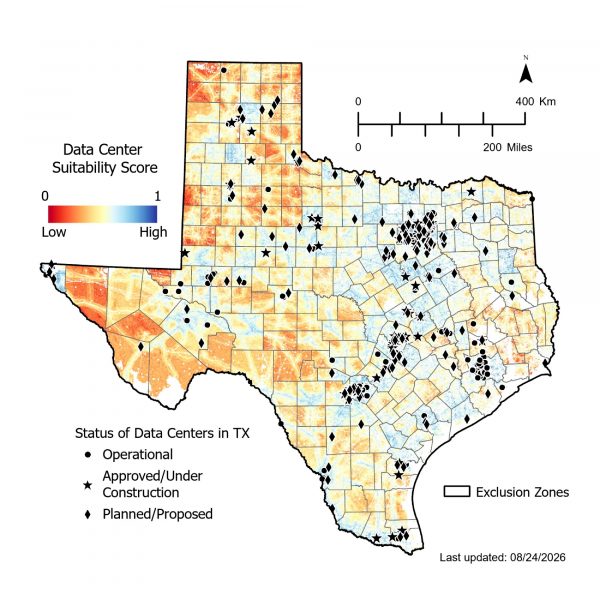
COMPASS has also built a database of more than 660 Texas data centers in various stages of development. About 370 are operating. Others are approved or under construction, and approximately 180 are planned or proposed.
The proposed facilities also represent a change in scale. Existing data centers average less than 100 megawatts, while planned facilities average close to 1,000 megawatts, Lin said.
To understand what draws developers to particular locations, researchers assembled nearly 100 layers of geographic data covering electricity and transmission infrastructure, pipelines, available land, skilled labor, fiber-optic networks, and natural hazards such as flooding and seismicity.
Researchers used machine learning to examine which characteristics are associated with existing data center locations. They then produced a statewide suitability map showing how resources and infrastructure align with potential future development.
The map identifies places with characteristics that are attractive to developers. Whether a particular project fits a community’s water supply and other resources requires a closer look.
When researchers first published the analysis, Lin said, people questioned why Pecos County and parts of the Panhandle appeared highly suitable despite the area’s overall lack of development. Soon afterward, Microsoft and Chevron announced dual facilities in Pecos County, with Microsoft building the data center and Chevron building a dedicated 2.67 GW natural gas plant to power it (enough to power about 2 million homes). This project demonstrated that the analysis was accurate, Lin said, adding that the area’s draw includes abundant natural gas, transmission infrastructure and other industrial infrastructure already in place.
A map can help explain what makes a location attractive to developers. Evaluating a project’s demands on local resources requires another layer of analysis, particularly when it comes to water. Data center equipment produces heat that must be removed to keep it operating. How much water a facility requires depends in part on its cooling system and how much water is used to produce its electricity supply.
COMPASS researchers estimate that data centers could account for 3% to 9% of Texas’ total water use by 2040, depending on industry growth, cooling technology and the sources of electricity powering the facilities. The estimate includes both water used at the facilities and water used to generate their electricity off-site.
The connection between power and water complicates the task of evaluating individual projects. At a recent industry panel hosted by Datacloud USA in Austin that focused on securing power for new facilities, panelists said electricity is no longer the only — or necessarily the most difficult — constraint. A viable project must also address water, permitting, financing, technology, grid impacts and community acceptance.
Several panelists said the industry’s historic reliance on nondisclosure agreements, shell companies and confidential land purchases has backfired, leaving communities and officials scrambling to catch up.
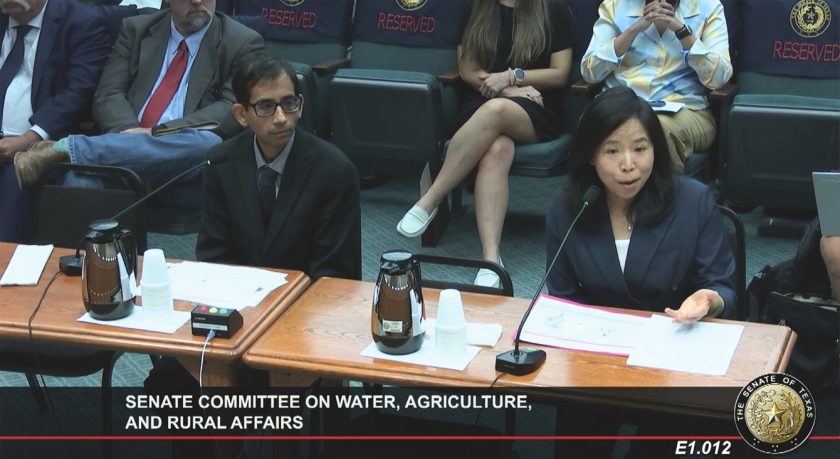
Water use has become a particular flashpoint. Many companies say they use closed-loop systems to minimize consumption but have been reluctant to publicly discuss their technologies, citing competitive business concerns. At a recent hearing of the Texas Senate Committee on Water, Agriculture, and Rural Affairs, committee chair Sen. Charles Perry, R-Lubbock, pressed industry representatives for greater disclosure.
“There will be no confidentiality on water use,” Perry said. “Your business model needs to work differently because you’re asking for a public resource.”
Disclosure is one part of the problem. Making that information useful also requires agreement about what is being measured and how. COMPASS’ meetings with industry representatives, state and municipal officials and community organizations have identified a need for a consistent framework for analyzing data center water use.
“We need shared definitions and a common framework. Right now, conversations around data center water and energy are often inconsistent because people are using different assumptions and metrics,” Lin said. “We need to create a common language that supports better decisions and more productive conversations by building a clear and consistent framework.”
That need for independent information surfaced at the Senate committee’s Sept. 1 hearing, where Lin testified alongside COMPASS collaborator Vaibhav Bahadur, a professor in the Cockrell School of Engineering’s Walker Department of Mechanical Engineering. Sen. José Menéndez, D-San Antonio, suggested that the researchers could help lawmakers identify best practices for reducing water and energy use.
“You guys could be an independent, unbiased source for us on best practices,” he said.
For local officials, resource questions come alongside concerns about how facilities will affect nearby residents. Thompson, the legislative director of the County Judges and Commissioners Association of Texas, said many developments are planned for construction outside city limits, where counties have limited authority to regulate them. Noise and light pollution are also growing concerns.
Counties are seeking authority to require buffer zones, water availability studies and public meetings at which developers explain their projects, Thompson said. He’s been in contact with COMPASS and said he looks forward to the group’s help as he works through the issues.
“I really appreciate those efforts working with our locals, getting the tools and information to help them make better decisions,” he said. “We really like the fact that it’s coming from an unbiased source, so it’s credible.”
A proposed data center raises questions that no single number can answer: where its electricity will come from, how much water it will need, and how it will affect its neighbors. COMPASS’ work brings those questions together, so communities can evaluate development with a fuller picture of its demands.
For Lin, the work comes back to giving communities a reliable basis for decisions about the development headed their way, whether it be data centers or the next big thing.
“Every community should feel that it has somewhere it can go to look at the data — not just for data centers today, but for the next development next year, whether it is a mining company or something else,” she said.
COMPASS has conducted research on many aspects of data centers in Texas. To date, the white papers it has produced are:
- Permitting Procedures for Setting Up Data Centers in Texas
- On-Site Power Generation Technologies Reshaping the Future of Data Centers
- Water Use Requirements for Data Centers in Texas: A White Paper on the Evolving Demands of Water Use in Data Center Infrastructure in Texas
- Geospatial Suitability Analysis for Data Center Placement: A Case Study in Texas
- Data Center Growth in Texas: Energy, Infrastructure, and Policy Pathways
For more information on COMPASS and its research, go to compass.beg.utexas.edu.