Linking Up
The U.S. is building a new critical mineral supply chain. UT geologists are helping make it happen.
By Monica Kortsha
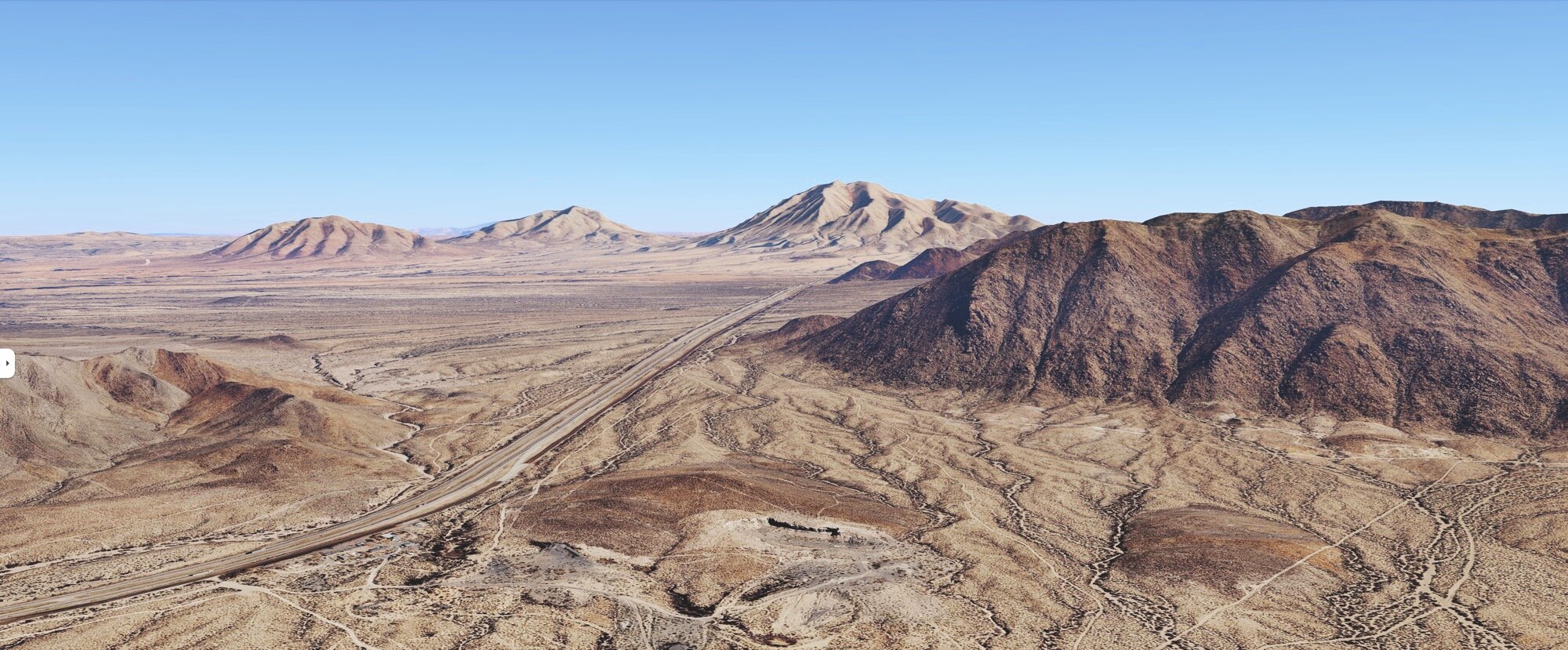
A view of a portion of the Sierra Blanca Laccolith Complex, showing (from left, in background) Round Top, Little Blanca and Sierra Blanca. Located along Interstate 10, the peaks are among the largest known deposits of heavy rare earth elements. The darker colored hill in the foreground is not part of the Sierra Blanca Laccolith complex. Photo: Google Earth.
About 85 miles southeast of El Paso in Hudspeth County, right along Interstate 10, a cluster of five mountain-like peaks rises above the desert.
Called the Sierra Blanca Laccolith Complex, they are among the largest-known deposits of heavy rare earth elements on the planet.
Since the 1960s, geologists have been studying the mineral potential of the peaks. But that potential has largely stayed on paper. Starting in about the 1990s, if a company needed rare earths — which are used in everything from electric vehicles to defense systems — it procured them from China.
But that’s starting to change.
The U.S. government is working to build a new domestic supply chain for critical minerals from the ground up. Taking a “mine-to-magnet” approach, the government is providing billions for academia and industry to bolster supply and build up processing and production capacities.
Research led by the Jackson School of Geosciences is playing a critical role in this initiative, with scientists at the school’s Bureau of Economic Geology and Department of Earth and Planetary Sciences leading the way in research that is helping companies find and make use of supplies, from geologic deposits to more unconventional waste streams such as coal ash, produced water and bauxite residue.
One of the best examples has its start among the laccoliths.
In 2018, Brent Elliott, a research associate professor at the school, published a paper describing mineral the composition of all five peaks of the Sierra Blanca Laccolith Complex.
A geochemist and economic geologist at the bureau, Elliott is one of a handful of geologists who had an eye on the peaks long before the current swell in critical mineral interest. From 2012 to 2015, he studied them as part of an initiative funded by the U.S. Geological Survey (USGS) focused on mapping rare earths and uranium resources in West Texas.
“I picked that quadrangle map just because of all the potential resources that were there,” he said.
Now, over a decade later, the company El Paso Minerals is planning to explore and develop the two largest of the laccolith peaks — Little Blanca and Sierra Blanca — thanks in large part to the research presented in the 2018 paper.
Elliott’s results suggest that Little Blanca has a higher concentration of heavy rare earths than Round Top, the peak that had received the most attention over the years. Round Top is currently being developed for mining by USA Rare Earth (which received access to $1.6 billion from the government to fund the effort) and is on track to begin production in 2028.
When Jim Levy — a UT Austin geology alumnus (B.S. 1973) and now operating partner at El Paso Minerals — saw the results, he was inspired to take his own samples and present them to Cesar Gonzalez, the co-founder and CEO of the company, along with additional research led by The University of Texas at El Paso (UTEP).
“He gave me a litany of reports, and he said the best one was published by Dr. Brent Elliott in 2018,” Gonzalez said.
Levy’s pitch — backed up by Elliott’s and other geoscientists’ results — inspired Gonzalez to make plans to develop the two largest laccoliths in the complex.
Last year, the company started quietly negotiating mineral rights leases with a patchwork of landowners while Gonzalez worked with William D. “Tex” Gross, the chair of Commerce Street Capital, a UT Austin alumnus (B.A. 1965) and a member of the UT Development Board, to raise millions from private investors. And in August, El Paso Minerals entered into two new mineral leases with the Texas General Land Office, covering more than 1,000 acres of the Sierra Blanca Laccolith Complex. A press release from the office described the deal as a “major step toward establishing Texas’ first dedicated rare earth mining district.”
With the initial groundwork complete, El Paso Minerals is beginning its first drilling campaign at the Little Blanca laccolith this fall.
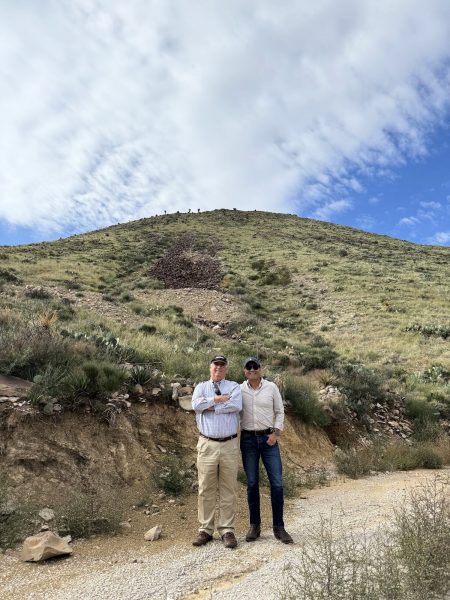
“I give a lot of credit to the academic community here in Texas, particularly at UTEP and UT Austin for building the body of empirical evidence that helped lay the groundwork for the commercial development of this district, helped attract significant government investment, and ultimately gave us the confidence to have taken on and advance our project,” Gonzalez said. “We don’t have to go to Brazil or other foreign jurisdictions. We have the critical minerals we need here in Hudspeth County, Texas.”
As El Paso Minerals prepares to retrieve its first drill core samples from within the Little Blanca laccolith, Elliott is serving as a resource and generally checking the pulse of the project as it develops.
With the national funding helping fuel research and industry across critical minerals, Elliott is among a cohort of researchers at the Jackson School who are expanding the scope and reach of critical mineral research across the school.
What’s more, they are also serving as mentors for the next generation of geoscientists who will be a key to the success of building up a critical mineral supply chain that can last.
“Geoscientists have the skills and knowledge to help solve some of society’s most pressing issues,” said Danny Stockli, dean of the Jackson School of Geosciences. “Securing a domestic supply of critical minerals is one of the most important and one that has geosciences at its very core.”
Finding Supply
During the past decade, Elliott said that he has seen interest in critical minerals explode.
Before 2018, the United States didn’t even have an official list of designated critical minerals. Now the USGS recognizes 60 of them, with the list including rare earth elements and more familiar metals, such as copper and silver, which are projected to face supply crunches in the future as demand continues to rise. The federal government’s Project Vault has designated $12 billion to build up a national reserve, akin to the nation’s petroleum reserve.
Geoscientists have the skills and knowledge to help solve some of society’s most pressing issues.
Danny Stockli
But despite their name, rare earth elements aren’t really rare. The issue is finding them in concentrations and locations that make production worthwhile. Their general abundance in the Earth’s crust is about 150-240 parts per million (ppm). Compare that with the Little Blanca laccolith’s abundance of about 404-669 ppm — more than 65% of which are heavy rare earths — within a formation that is free from the usual overburden of soil and vegetation, which helps facilitate the mining process.
A big focus of the critical mineral research happening at the bureau involves searching for the “sweet spots” like the Sierra Blanca Laccolith Complex, where critical minerals are present in worthwhile quantities, accessible and extractable, Elliott said.
Carrying out this research has taken him across Texas, giving him a firsthand view of what’s happening on the ground.
“I pretty much know all the operators. I know all the companies, the ranchers and everyone else,” Elliott said. “I’m a matchmaker, a proposal writer. In a lot of ways, I facilitate the work.”
That makes him a good person to know when scoping out potential resources for development, said Chris Young, the chief strategy officer of ElementUSA, a critical minerals company that provides services across the supply chain, from assessing mineral resources to extracting them from waste products, like bauxite residue and salt dross.
“Brent understands the resource constituency across the state, really beyond the state, and just has some good tools from a geological and geospatial standpoint that can really help,” Young said.
ElementUSA recently opened a Critical Resource Accelerator in Cedar Park to develop metallurgical methods for extracting critical minerals from different feedstocks.
It is just one of the companies that are focusing on critical mineral extraction by bypassing mining new sources and focusing on extracting metals from what’s already been dug out of the ground.
To that end, a recent stream of research at the school has focused on finding and analyzing industrial waste — such as bauxite residue, coal ash and produced water — that can be put to use in the critical minerals supply chain.
Trash to Treasure
In 2024, UT was one of six universities selected by the Department of Energy to receive a CORE-CM grant for critical mineral research. The principal investigator on the grant is Bridget Scanlon, a research professor at the bureau.
Scanlon has experience measuring, analyzing and forecasting big inputs. Some of her best-known work is on tracking regional water supplies as they move between surface water and groundwater.
With the CORE-CM research, she is leading work that looks into questions of access, use and economics for a range of resources, both natural and human-made. This includes petroleum industry waste, produced water and subsurface brine, coal, coal ash and other coal waste, sedimentary rocks, bauxite residue from alumina processing, drill cuttings and other subsurface materials.
“There’s a lot of waste. And you know, there are things we can do to get companies to invest and get them interested in processing,” Scanlon said.
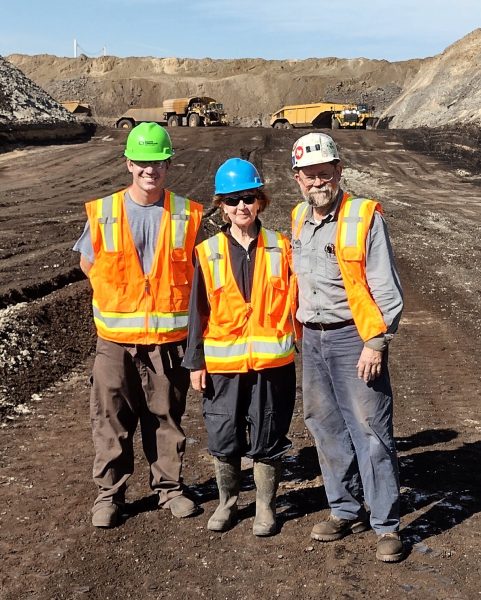
The CORE-CM grant includes industry partners that are interested in just that. They include ElementUSA and MaverickX, a company that recently moved to Austin from San Antonio and uses a proprietary bacterial enzyme to dissolve rock and liberate critical minerals from a range of geologic materials.
By forging partnerships between UT and critical mineral companies at the research stage, insights from both players can be more easily shared, said Young.
For example, the CORE-CM grant is funding research into deposits of bauxite residue, sometimes called red mud, at storage sites along the Gulf Coast that hold hundreds of millions of tons of the residue in pools or in dried-out mounds.
Preliminary research on five sites has found elevated levels of rare earth elements, with the average concentration being about 10 times that ofthe crust. At the Copano site alone, researchers found that $8.7 billion worth of rare earth minerals could be present in its more than 3,000 acres of storage beds. Richard Kyle, a professor emeritus at the Jackson School, recently led a study that analyzed the site from a variety of vantage points — from the structure of the beds holding the residue to the chemical composition of the red mud inside it. A key aspect of this study was to emphasize the societal and environmental benefits of repurposing all of this waste material for beneficial products in concert with critical minerals production.
At the same time, ElementUSA is taking on the next step of producing rare earths from bauxite residue. Earlier this year, the company, in partnership with the Colorado School of Mines, received a $67 million grant from the Department of Energy to build a plant for extracting rare earth elements and pig iron from bauxite residue in Gramercy, Louisiana. That’s on top of a $29.9 million grant the company received from the Department of Defense in 2025 for a prototype plant.
Young said that bureau research has helped give the company a larger understanding of critical mineral supplies in the area and potential opportunities that can stem from them.
“Brent and Bridget have built really good resources in terms of understanding the broader unconventional resources for waste-to-market type opportunities,” he said.
Some of the biggest findings to come from the CORE-CM grant so far concern the critical mineral potential of coal and coal ash. A 2024 study led by Scanlon found that there could be 11 million tons of rare earth elements in the accessible coal ash supply in the U.S. — nearly eight times the rare earths that the country has in domestic reserves. The total value of this supply is $8.4 billion.
A 2026 study, also led by Scanlon, examined coal resources along the Gulf Coast. When coal and coal ash are counted together, they could hold a total of $187 billion worth of rare earths. These rare earths can be extracted from the coal before it’s burned for energy.
However, the study also calls attention to nuances of extraction and economics. The actual yield of critical minerals can vary widely, from 5% to 70%, depending on whether the source is coal or coal ash, and whether a strong or more environmentally friendly weak acid is used during extraction. And all else being equal, the costs of producing the rare earths are probably too much for a stand-alone industry to develop around critical mineral extraction from coal materials. However, it could be a good source of revenue for companies already working with these inputs.
“This may be low-hanging fruit for ash that’s coming out of power plants,” said Scanlon. “It’s going to go into a compartment somewhere, into a hole, so why not treat it and get something out that’s beneficial.”
Eyes on Lithium
One of the biggest areas of potential for the critical mineral industry in Texas is currently one of the oil and gas industry’s biggest headaches: produced water.
Produced water is salty water that accompanies oil and gas up to the surface when a reservoir is tapped. The Permian Basin alone produces more than 22 million barrels of this waste product each day— more than twice the number of barrels of oil produced.
This has left the energy industry on the hook to dispose of most of it; only 7 million barrels of produced water per day are currently recycled as part of hydraulic fracturing operations in West Texas oil fields.
But according to Lorena Moscardelli, the director of the Bureau of Economic Geology, produced water could be a resource of its own, offering a readily accessible domestic source of lithium, a critical mineral that is essential for batteries.
“I think the potential is there for the state to really lean on this,” Moscardelli said.
Currently, about half of the global lithium supply comes from mineral-rich brines, salty subsurface water that is pumped to the surface specifically for lithium extraction. The idea is to treat produced water like these brines—turning a byproduct into a raw material for lithium extraction.
At the Jackson School, scientists are conducting foundational work into lithium levels in produced water from across the state.
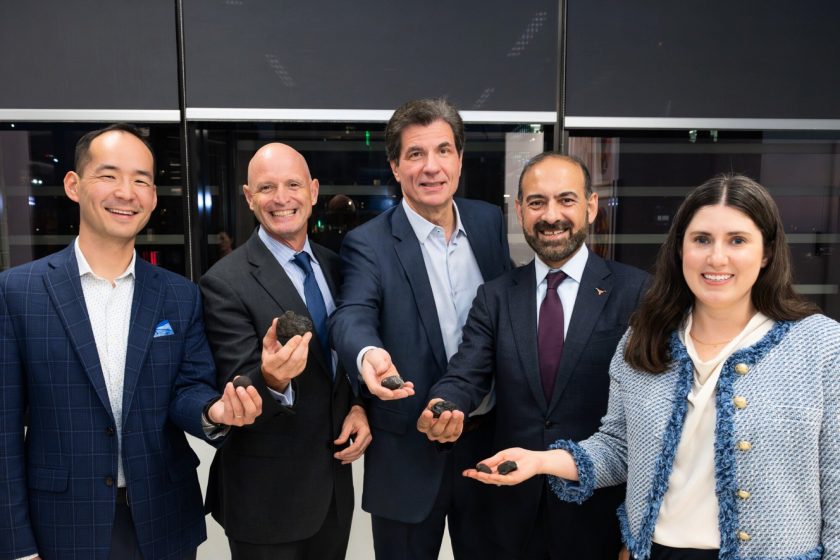
J.P. Nicot, a research professor at the bureau, has been studying produced water and its geochemistry in Texas for over two decades. In 2024, he and then- bureau scientist Roxana Darvari spearheaded a study that looked into lithium concentrations in more than 2,000 oil field water samples from across Texas and neighboring states. The research was funded by the CORE-CM grant and co-authored with Scanlon and Elliott.
While the Permian Basin was found to have relatively low levels of lithium (in the <1-40 milligrams per liter range), the sheer quantity of produced water available could make extraction worthwhile, Nicot said.
“Production wells and wells reinjecting the produced water exist no matter what, and lithium extraction can piggyback on it,” Nicot said.
The Smackover Formation, which spans from southwest Arkansas with extensions into East Texas, is a smaller hub of oil and gas activity compared with the Permian. However, the study highlighted that it’s a hot spot for lithium—with some areas having 10 times the concentration of what’s typically found in produced water in the Permian. These high levels have piqued interest in produced water in the region as well as brine extraction just for lithium recovery.
Moscardelli has made lithium research one of the key research priorities at the bureau, with research scientist associate Dallas Dunlap leading current efforts. It’s part of the Texas Imperative, an effort that focuses on putting together reports on state resources relevant to policymakers, industry and the public.
In addition to understanding the supply, she said that matters of engineering and policy are just as important. Jackson School researchers are looking into these areas as well.
Before joining the Jackson School in 2025, Dan Alessi, a professor in the school’s Department of Earth and Planetary Sciences and at the bureau, co-founded Recion Technologies, a company that extracts lithium from produced water from Canadian oil fields. Alessi is now developing materials that can efficiently and rapidly extract lithium from Texas brines. Brendan Bishop, a postdoctoral fellow in Alessi’s group, is leading research on the sources of brine lithium in North Dakota and Texas, working with collaborators at the USGS and the North Dakota Geological Survey.
On the policy end, Shipra Mishra, a research scientist associate at the bureau, and Dunlap are conducting research on regulating lithium extraction. There are currently no regulations on the books governing lithium extraction from produced water specifically, and there are big open questions concerning mineral rights and royalties, property taxes, and injection regulations.
By making concurrent progress on supply, engineering and policy, Moscardelli said researchers can help lay the groundwork that the industry needs to grow.
“You need the geoscientists. You need the engineers. You need the policymakers,” she said. “You have to have the policy component too, because it has implications in terms of how you want to, and if you want to, develop these resources.”
Future Forward
Bridging the gap between research and product is one of the most precarious stages in building a business. It even has its own sinister name: The Valley of Death.
While universities are an essential part of the product development process, the foundational research they focus on often has a harder time breaking out into the wider world, said Marek Locmelis, an associate professor at the Department of Earth and Planetary Sciences and the bureau.
“It dies off in what’s called ‘the ‘alley of Death’ because at this point, you would need investors to get it to the next level. You would need cross-disciplinary collaborations to get it to the next level,” Locmelis said. “But a lot of the academics usually do not have those kinds of relationships.”
Locmelis does.
He is an economic geologist who studies the processes that drive where and how critical minerals form. During his career, he has forged connections with mining companies domestically and internationally that are interested in how geochemical or geological data can improve mineral recovery.
During the past five years, he has been working to foster more connections between academics, policymakers and business leaders by hosting a critical minerals workshop for everyone.
He launched the first workshop in 2021 when he was at the Missouri University of Science and Technology. When he joined the Jackson School in 2024, he revamped it into an even bigger event.
The UT workshop in 2025 was a hit, drawing over 230 participants working in critical minerals from academia, industry and policy.

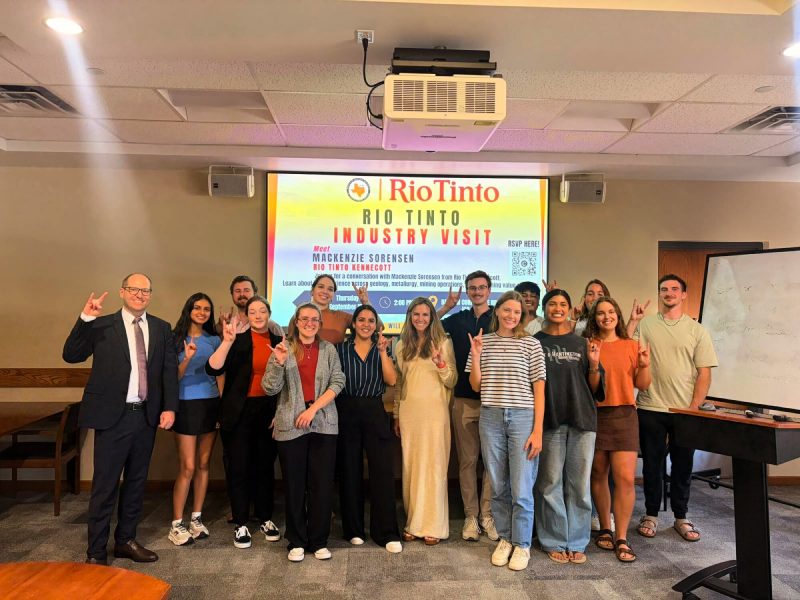
The workshop was particularly well attended by students in the Jackson School’s Energy and Earth Resources master’s program, Locmelis said. This program is geared toward students interested in industry careers in geosciences, policy or business. These students could tap into discussions happening across the supply chain.
But as the need for critical minerals continues to grow, the Jackson School is preparing geosciences students across the board to take advantage of the critical mineral boom, Locmelis said.
“We have a lot of responsibilities to make sure that we are really producing students that are ready to hit the workforce and are really prepared for what real life has in store for them,” he said.
One of his master’s students, Paola Salas Rivera, is doing her part to build community around critical minerals and mining at the Jackson School and UT. This fall, she founded the UT student chapter of the Society of Economic Geologists (SEG). The chapter already has a close connection with the main organization through Locmelis, who is an SEG fellow and chair of its graduate student fellowship program.
Salas became interested in critical minerals as a geology undergraduate at UTEP and came to the Jackson School to study deep critical minerals deposits with Locmelis. She is researching how valuable metals, such as nickel, copper and platinum-group elements, became concentrated in rocks deep beneath the Italian Alps.
She said she started the UT chapter of SEG to help students, particularly undergraduates, learn about what working in the industry is actually like. Advancements in technology and policy mean the domestic mines of the future may look very different from the mines of the past. Salas said that the rise of a domestic industry is a chance for geoscientists to not only find needed commodities, but also do so in a sustainable way.
“I would like to be in the mining industry in order to help society and help change the way they think about mining,” she said. “At the same time, I want to help mining change.”
Anna Scott, the CEO and co-founder of Austin-based Mithril Minerals, understands that sentiment.
Before joining the startup world, she was a geoscientist studying climate change. She earned a Ph.D. in Earth and planetary sciences from Johns Hopkins University and conducted field work around the world on global heatwaves.
At Mithril, she is developing a fleet of autonomous robots that can selectively sweep up mineral precipitates called polymetallic nodules from the bottom of the ocean while leaving the surrounding seafloor largely undisturbed. The company’s name reflects its environmentally conscious roots. Mithril is a fictional precious metal from The Lord of the Rings books that is sought-after because of its value — but leads to destruction when it’s overmined.
“It’s my hope for the future that as we dig more stuff out the ground, whether we are onshoring defense supply chains or electrifying our energy system, we can come up with better ways to produce these commodities,” Scott said.
Scott said that her geosciences education gave her the background she needed to make the pivot to entrepreneurship, with Mithril being her second Earth science company. In 2018, she co-founded Project Canary, a company that measures methane leaks and helps reduce emissions for the natural gas industry.
Working in Austin, Scott has been able to build ties with researchers working in the critical mineral space, including Locmelis and other UT scientists. She said that Texas is well positioned to meet the critical minerals moment.
“Texas has a real unique opportunity to be a leader in this space,” she said. “There’s UT Austin and the Jackson School of Geosciences, and our own domestic resources here, also, but I think our willingness to take on tough industrial projects, our willingness to permit them, and our willingness to support them financially matters, too. I think if we can do that with a long-term view, Texas will be a really exciting place in the decades to come as our energy system changes and our mineral system changes.”
While there are many parts to building out the critical mineral supply chain, if there is one thing that can link laccoliths in West Texas to bauxite residue and coal ash along the Gulf Coast, to produced water across Texas, to minerals on the floor of the ocean, it’s geosciences.
“The Jackson School is primed to be a leader in critical minerals research for the same reason we are a leader in geosciences as a whole,” said Stockli. “We have the depth and breadth to do it all.”