The Notebook
How one grad student’s field notebook went from lost, to #trending, to found
By Monica Kortsha
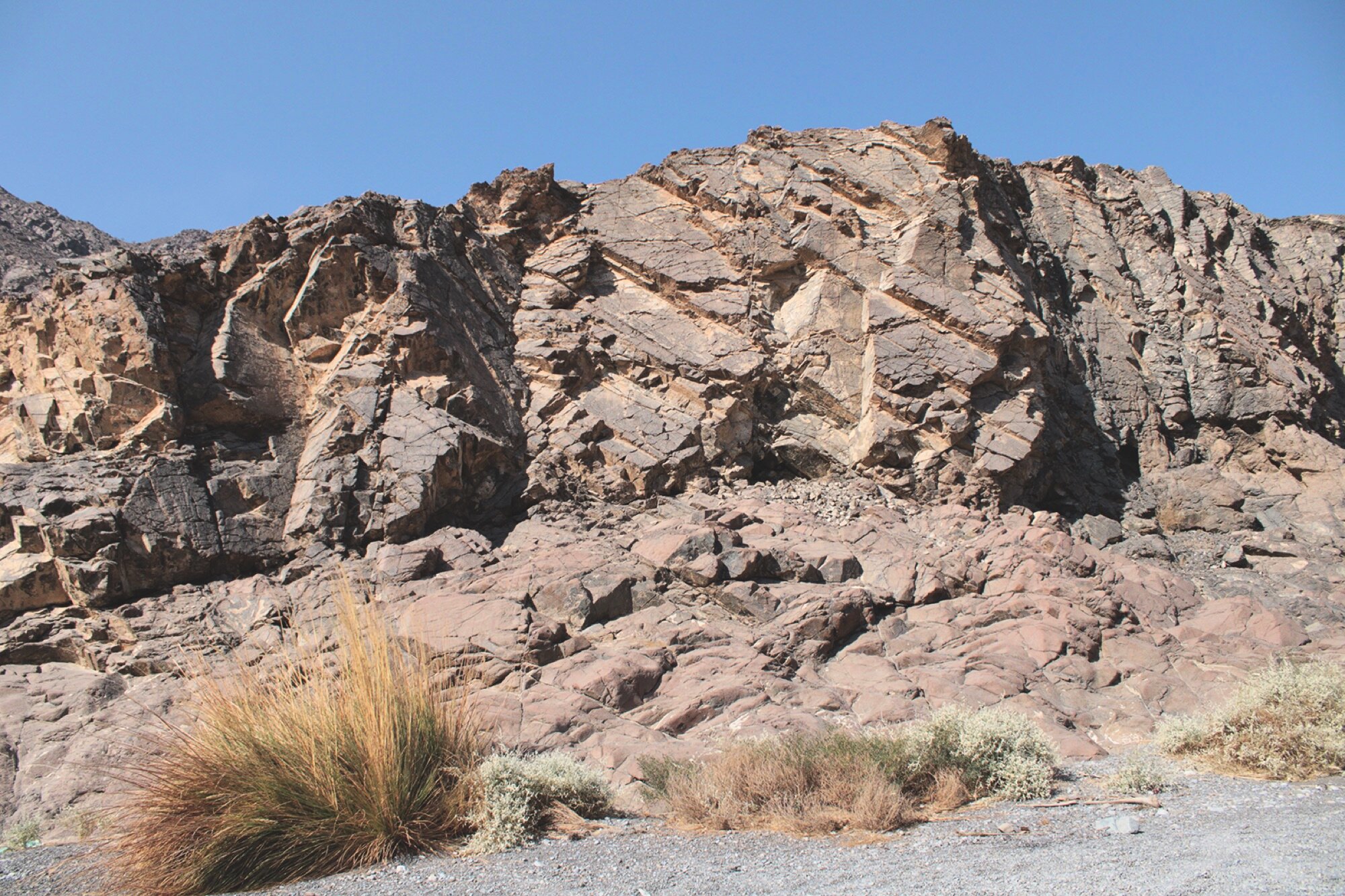
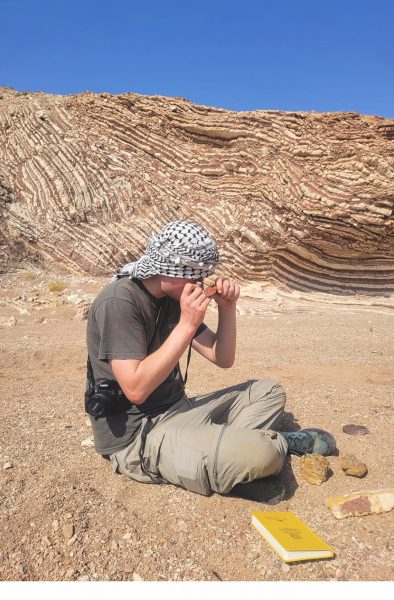
The Moho outcrop near where the notebook was lost and found. Mantle rocks are at the bottom. Gabbros are at the top. Photo: Thomas Forster.
When graduate student Mitchell Casazza enrolled in GEO 381K “Tectonic Problems,” one of the first things he did was get a dedicated notebook.
The graduate-level seminar class is known for its epic international field trips. The Spring 2026 cohort would be heading to Oman with Dean Danny Stockli and Assistant Professor Craig Martin for 10 days of field geology in the desert.
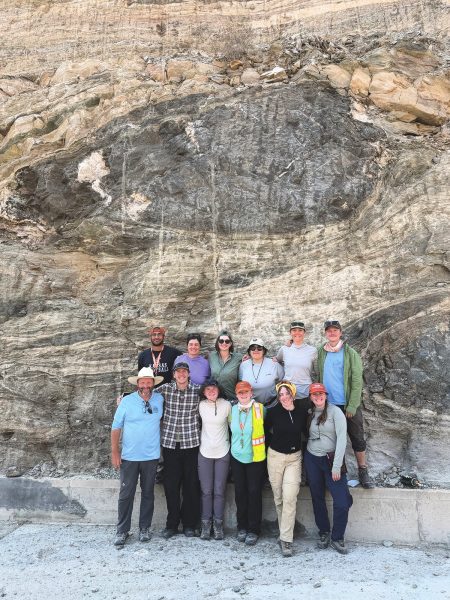
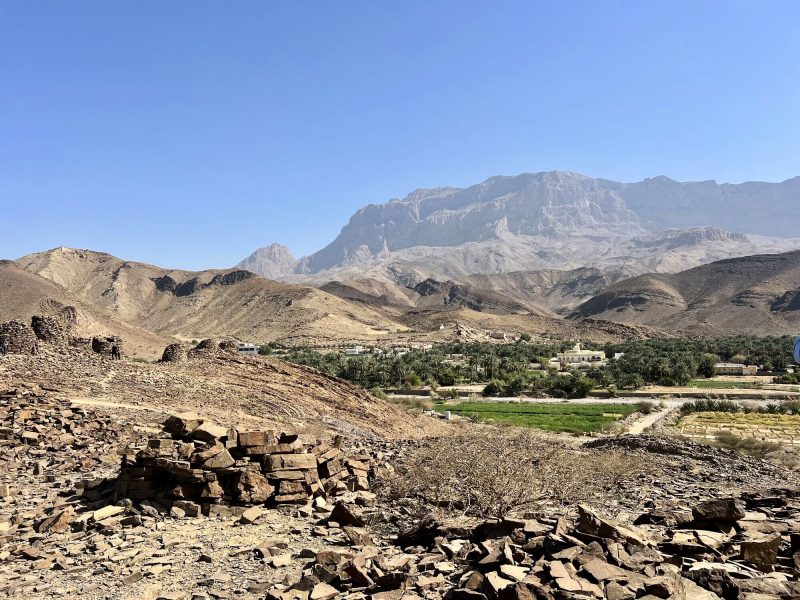
Oman is a geologist’s dream. Located on the Arabian Peninsula, it’s home to world-renowned rocks from the Earth’s mantle and huge fields of scenic sand dunes. At the Samail Ophiolite, visitors can walk on a block of oceanic crust parked on top of a continent, see remnants of the mantle that were pushed up with it, and touch rocks that once made up the Moho, the dividing line between crust and mantle rocks.
Casazza wanted a notebook that would match the stature of the class. He opted for a Leuchtturm1917 in light gray, with two woven bookmarks and a built-in folder on the inside back cover.
As the class left for Oman on Feb. 18, he was feeling proud of his notation work. His first few pages were filled with notes from lectures, readings and conceptual sketches to aid him on the outcrops t.
But on the first day in the field, he lost his notebook, leaving it on a boulder almost exactly the same shade of light gray as its cover.
He didn’t realize it was gone until the next day, Feb. 20, when the group was hours away from the ophiolite. And all the neatly drafted geology notes couldn’t make up for one crucial oversight: He forgot to write his name and contact information inside.
“It was so sad,” Casazza said. “I did a full search of my bag, all of the car, and I was like, ‘Yeah, definitely, it’s gone.’”
But amazingly, 11 days after going missing, the notebook was back in hand.
Although light on field notes, it’s now a symbol for a new story — one that’s a testament to the tight-knit — and tenacious — geosciences community.
Lost & Found
Field and lab notebooks have a special place in scientists’ hearts.
The pages record impressions, observations, and half-formed thoughts that can turn into grand ideas. The seeds of Charles Darwin’s theory of evolution are famously recorded in his field notebook as a sketch of branching lines with the words “I think… .”
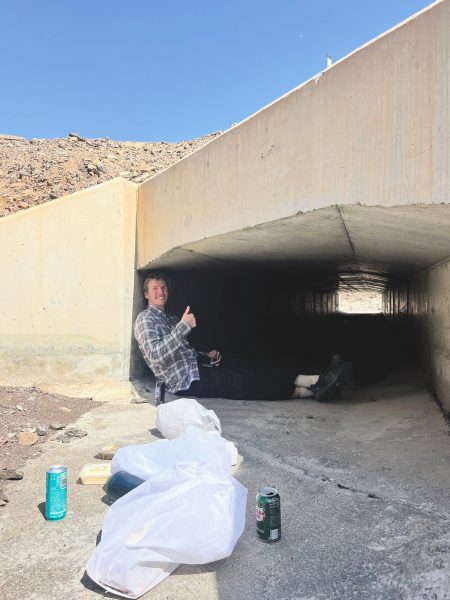
When a field notebook goes missing, it’s not unheard of for it to find its way back to its rightful owner. Certain field sites attract people from all over the world. And if a scientist stumbles across a lost notebook, they know the value it holds — both scientific and sentimental.
Just last year, the Jackson School received a student’s field notebook that was lost in 2020 during field camp. Someone from the Wyoming State Geological Survey found it and sent it home.
“Geologists, especially professional geologists, will go the extra mile to return a field notebook,” Stockli said.
So, when two German geologists — Professor Anke Friedrich and geosciences student Thomas Forster — spotted a notebook near the Moho, they were determined to find its owner.
“We were immediately very passionate about this notebook, because it was just a really well-kept and well-started notebook,” said Friedrich, the chair of geology at the Ludwig Maximilian University of Munich and the president-elect of The Geological Society of America. “We felt sorry for the person who left it, because obviously it was someone who cared.”
Friedrich was leading her own field geology trip to Oman. Without a name or contact, she, Forster and other students started to scour the notebook for clues.
It obviously belonged to a geologist; they suspected an American graduate student or professor based on the dating and writing style. But an American geologist in Oman is hardly unique.
They needed something more specific.
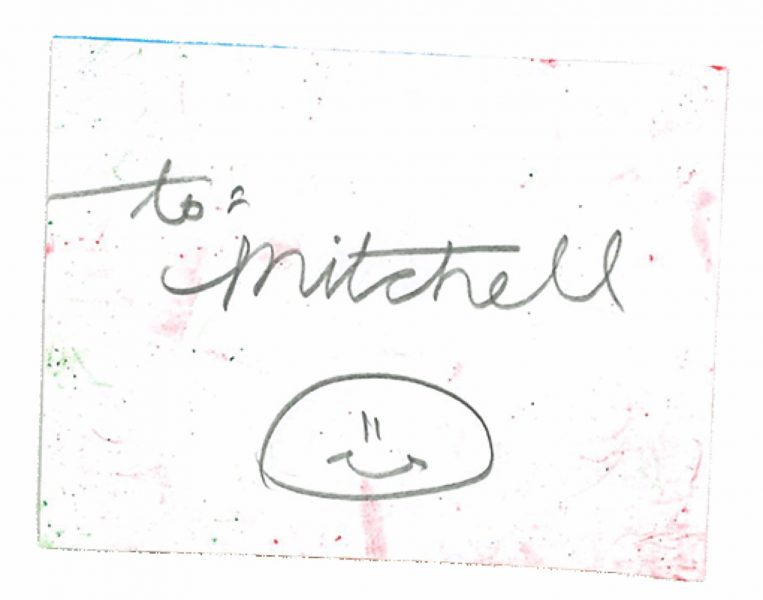
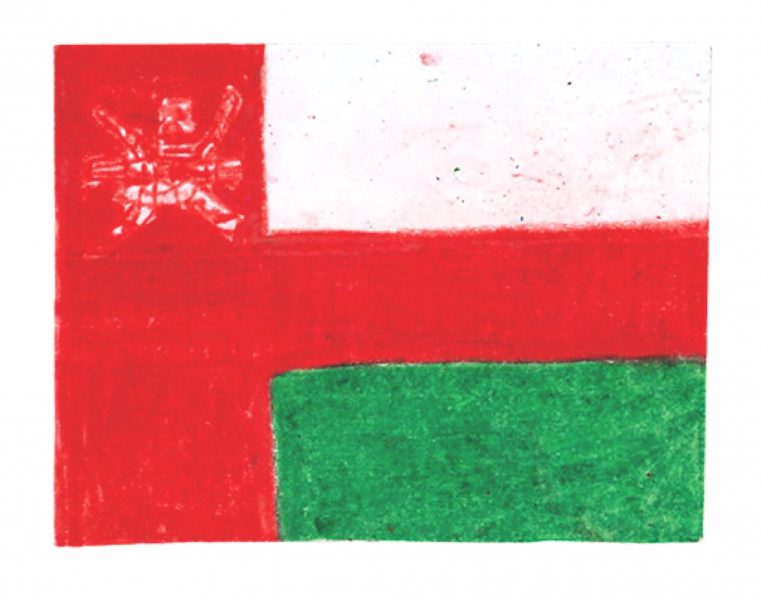
Then a couple of hours later, a breakthrough. In the notebook’s back folder, Friedrich discovered a small handmade card with a drawing of a geologist on an outcrop inside and the Omani flag on the back.
Casazza had received the card from his girlfriend’s sister as a parting gift. To the group, it was a thrilling clue. The front read: “To Mitchell.” They had a name!
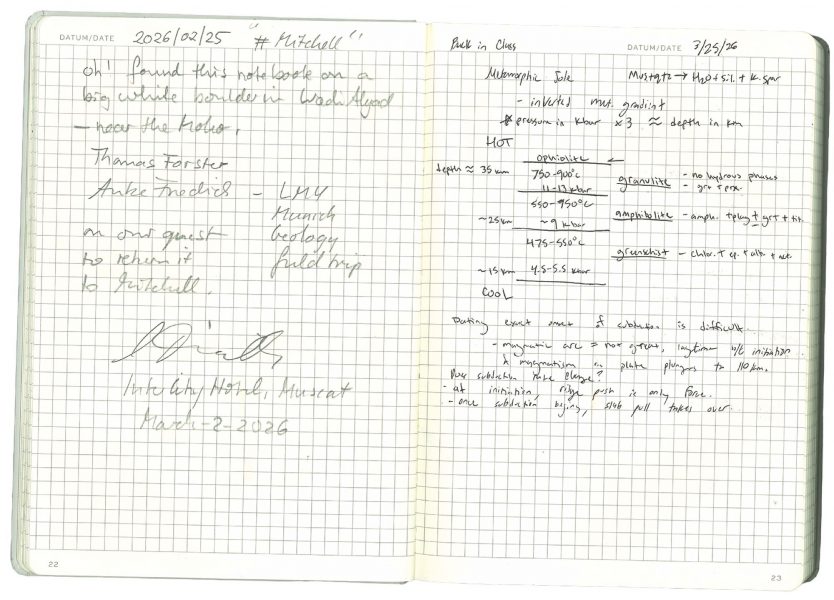
At this point, five days after Casazza had lost it, Forster and Friedrich were inspired to add their own entry to the notebook:
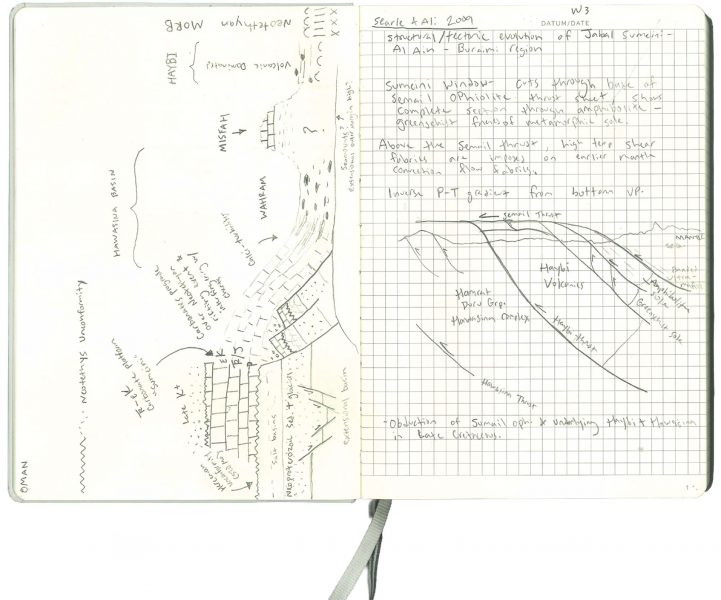
“Oh! Found this notebook on a big white boulder in Wadi Abyad — near the Moho. On our quest to return it to Mitchell.”
Forster had an idea of who could help them spread the word and find Mitchell.
#FindMitchell
Codi Lazar is an associate professor of geological sciences at California State University, San Bernardino. On social media, he is better known as @tectonic_city.
Lazar runs a popular Instagram page by the same name that shares geology memes and jokes (“What’s the best AI for geology? ChertGPT”) along with photos from his own research.
With 42,000 followers and counting, Lazar has a considerable reach in the geosciences community.
“Just about all my followers are geologists,” Lazar said. “I have a relationship with my audience … they know that I’m connected in the academic community. I am a professor, and I know other professors.”
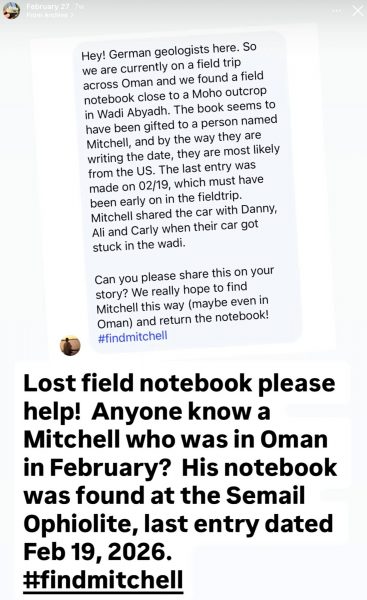
On Feb. 27, Lazar received a direct message from Forster: His geology group had found a lost notebook at the ophiolite in Oman. Could he help them find the owner?
Lazar obliged. His Instagram story included a screenshot of Forster’s message — which mentioned all the clues they had collected about the notebook thus far, along with the hashtag #findmitchell.
Among the clues was the name “Danny,” which was mentioned in the notebook’s final entry. This immediately caught people’s attention.
Lazar said that within a couple of hours, he had received three or four responses about the notebook, mentioning the same person: Danny Stockli.
Stockli had been sharing his own photos from the Oman trip on social media: desert valleys with cliffs and minarets, gnarled rocks, and selfies in a cowboy hat and mussar, the traditional Omani headwrap.
When Stockli checked his phone the morning after Lazar shared his post, he was bombarded by messages from people who had seen it.
“Text messages, Instagram messages, Facebook messages, all from friends from around the world,” Stockli said. “They had all texted me because they had seen this Instagram post.”
Meanwhile, Lazar shared Danny Stockli’s name with Forster. Friedrich was delighted when she heard the news.
“I’m like, ‘Danny Stockli? I know Danny!’”
She and Stockli had been postdoctoral researchers together at the California Institute of Technology in the 1990s, where they forged a friendship over a shared interest in science and skiing. She immediately reached out to Stockli on Facebook, while Casazza messaged Forster on Instagram to thank him for finding his notebook — and finding him.
Just 12 hours after Lazar’s Instagram post, #findmitchell was a resounding success.
“This is good internet, right?” Lazar said. “This is good internet where it connects people of common interests. It didn’t surprise me that we figured it out, actually.”
However, returning the notebook didn’t seem like an option.
That morning, the UT group was packing up from their camp in the Wahiba Sands to head to the Omani capital of Muscat. They had a flight to catch that evening back to Austin. The German geology group was out at the ophiolite, over 100 miles away.
But only a few hours later, everyone’s itinerary changed. War had broken out between the U.S. and Iran.
The Return
When Iran started to bomb U.S. allies in the region on Feb. 28, flights across the Middle East were grounded. A few days later, Saudi Arabian air defenses intercepted missiles that were aimed at the King Khalid International Airport — where the UT group’s flight from Muscat was heading.
The U.S. Embassy recommended all Americans shelter in place. The group hunkered down in the Muscat hotel where they started their journey while Stockli and co-lead Assistant Professor Craig Martin worked with the Jackson School’s administrative staff back home to find a flight back that could accommodate all 15 people in their group.
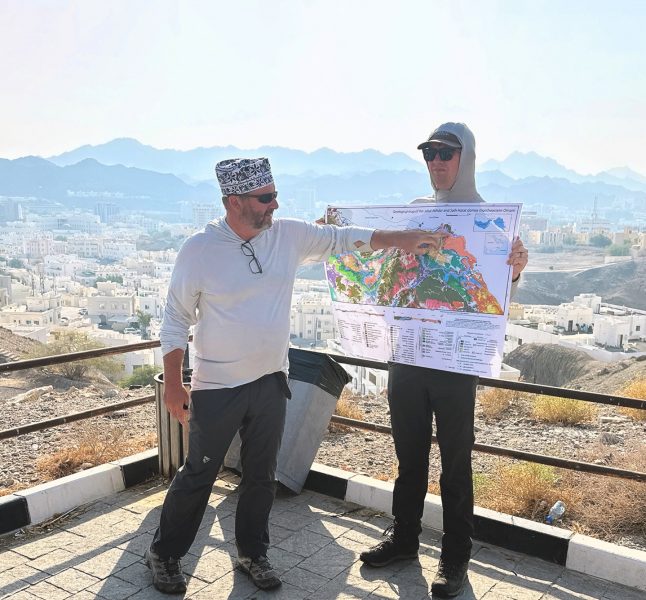
Oman is a neutral country in geopolitical affairs between the United States and the Middle East. Casazza said that he never felt unsafe. He said that the war’s impact was most evident by the droves of tourists from neighboring countries, like the United Arab Emirates, who showed up in Oman for safety, trying to catch a new flight home.
Casazza and the rest of the group passed hours at the hotel’s beach on the Gulf of Oman, where ships and planes from the Omani armed forces could be seen patrolling the narrow body of water that separates the country from the shores of Iran.
The German geology group was grounded too. While much was uncertain, Forster and Friedrich knew one thing — they wanted to return the notebook. Now they had time to do it.
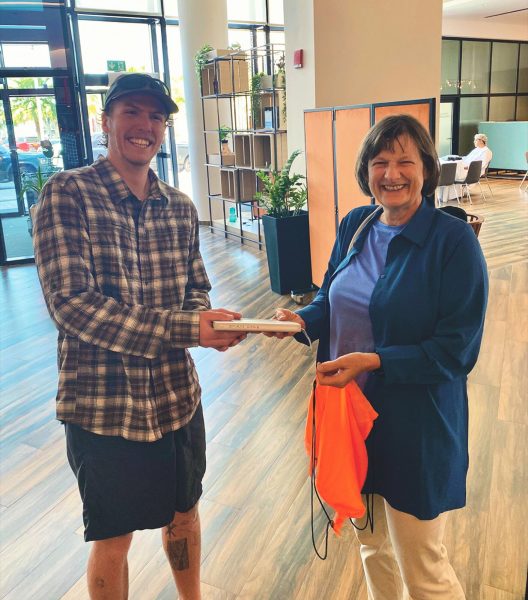
On the morning of March 2, they completed their quest. Casazza got his notebook back.
It came along with a spare one, a gift from Forster branded with his own university, the University of Tübingen. Casazza and Stockli gave Forster a burnt orange Texas Geosciences cap.
Stockli said the actual notebook handoff resembled a diplomatic meeting. There were handshakes, photos, and Friedrich signing a page in the notebook before passing the now-storied tome back to its rightful owner. (Unfortunately, Forster couldn’t be there. He had to dash to the airport to try — and fail — to make a flight.)
Casazza said that the saga of the lost notebook gave him a renewed appreciation for the geosciences community, and how a shared profession unites people around the world.
“It’s a really cool testament to the geology community and geologists in general,” Casazza said. “Anywhere in the world, just because we’re into the same science, people feel totally connected and are willing to go out of their way to do stuff like that.”
Getting home to Austin was a story of its own. After five days of waiting in Muscat, it involved taking the “long way” back around the Earth. The group traveled from Muscat, to Manila, to Tokyo, to Dallas — and finally, after a six-hour delay — landed back home in Austin.
It took 55 hours total. And everyone made it back safe and sound, including the notebook.
Field trips like this are meant for connection and learning lessons, Stockli said. This trip certainly epitomized it. One of the lessons being the most basic: Put your name in your notebook.
“It will be a less interesting story, but there’s a better chance people will return it to you,” Stockli said.