Urban Paleontology: Ecological Change and Continuity in Austin
By Brisa Bustos, Lucille Collier and Ira Kadam, undergraduate researchers
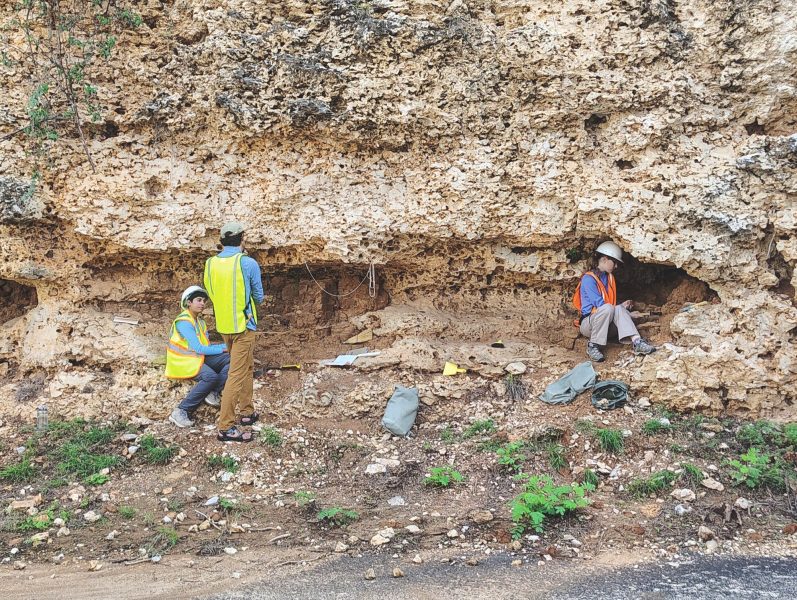
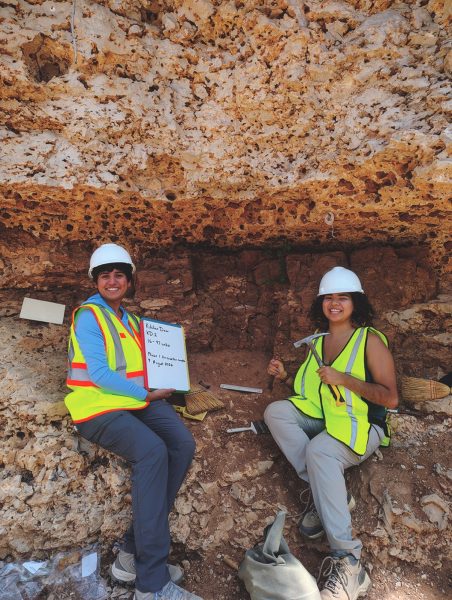
In the back alley of a strip mall, a wall of crumbling Edwards Limestone bakes in the Austin sun. This unassuming wall was once an active quarry that exposed a hidden cave called Kitchen Door, home to the oldest known Pleistocene fossil assemblage in Central Texas. Caves are important resources because they accumulate and preserve fossils and sediments, which provide a snapshot of past ecology. Studying the animal community represented in Kitchen Door will help us better understand what the local environment looked like in the past and how the Austin we recognize today came to be.
Kitchen Door has an unusual appearance. Quarry operations destroyed an unknown volume of the cave, leaving parts of its interior exposed. The cave openings are large holes in the limestone wall, with a cross section of the sediment inside visible. While this makes the dig site more accessible, it also presents unique challenges since we don’t know what the cave might have looked like in the past.
Working from the top of the cave to the floor, we collect and bag sediment corresponding to each stratigraphic layer. Back at the lab, we screen-wash the collected material before searching for fossils under microscopes. By identifying which animals are represented in each layer, we can gain an understanding of how local animal communities changed through time. Additionally, we are working with researchers specializing in paleomagnetism, remote sensing, and paleoclimate proxies to better understand Kitchen Door’s history.
Perhaps most importantly, our experiences at Kitchen Door have made us feel connected to paleontology by introducing us to science in our own backyards. This field experience has been invaluable in developing our organizational skills, introducing us to research methods and faculty, and helping us feel confident doing research. We are thankful to Drs. Moretti and May.