The Permian Basin’s Next Challenge
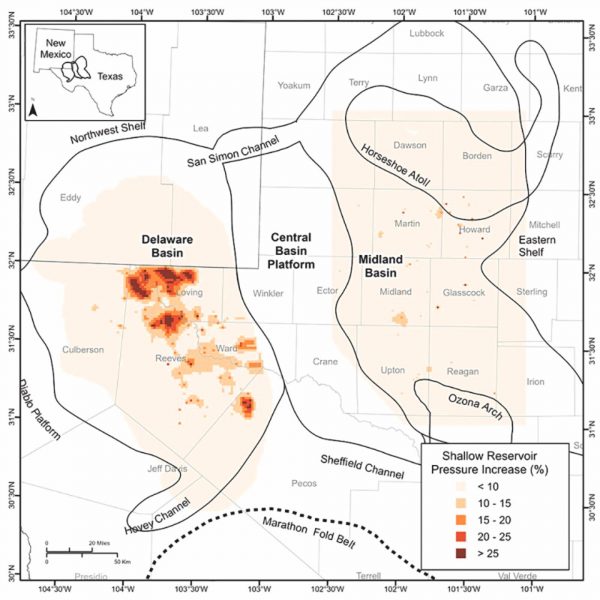
In the Permian Basin, injecting produced water into shallower reservoirs has helped mitigate injection-induced seismicity. However, it has also contributed to a emerging issue: pressure increases that can threaten groundwater or lead to surface brine release.
Produced water is briny water that’s brought to the surface during oil and gas production. Researchers at the Center for Injection and Seismicity Research (CISR) at the Bureau of Economic Geology say that operators, regulators and researchers must work together to respond to the emerging risk that shallow injection presents, including reframing how injection is managed at the basin scale.
This increasing pressure in shallow reservoirs is now encroaching on hundreds of thousands of aging oil and gas wells in the basin, some of which are unplugged or orphaned. The bottom of these wells often reaches the reservoirs that are currently targeted for shallow injection and may be at increased risk of failure depending on local subsurface conditions and well integrity.
Earthquake rates rose sharply in the Permian Basin from the 2010s onward. Most of these earthquakes are associated with deep injection of produced water into the reservoirs below producing shales. A recent curtailment of these deep injections has helped mitigate the rate and magnitude of earthquakes in the area. The vast volume of water produced daily in the Permian Basin is now being increasingly injected in shallower reservoirs between 4,000 and 6,000 feet underground. During the past decade, shallow injection rates have increased 500% in the Delaware Basin and 150% in the Midland Basin.
CISR’s reservoir models suggest that from 1983 through 2025, shallow injection reservoir pressure increased by as much as 25% locally in the Delaware Basin. In some places, the increases have been 1,000 pounds per square inch or more above the pressures these reservoirs held prior to injection.
Editorial published June 2026 in the Journal of Petroleum Technology
Research by Katie Smye, research associate professor
Bureau of Economic Geology