Reflections From the Edge of the World
By Jesse Houghton, scientific support staff
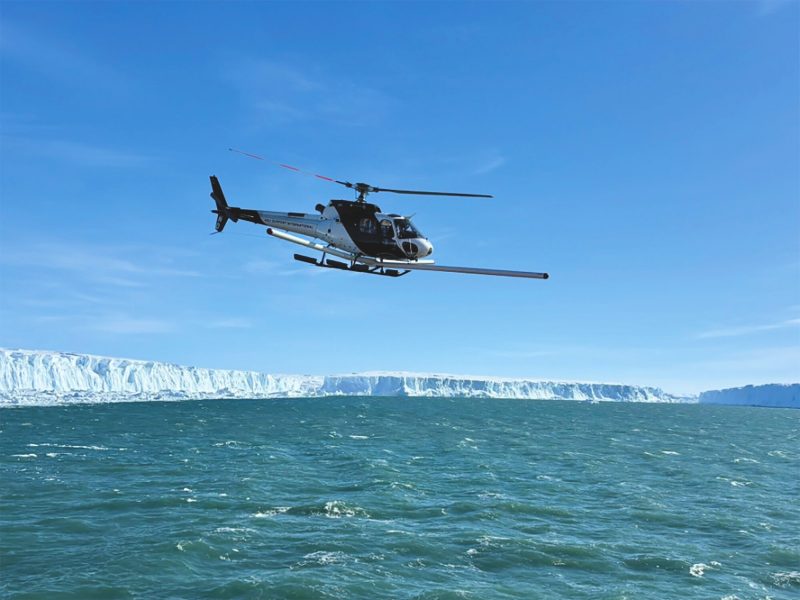
On Christmas Day, I boarded the Korean Polar Research Institute’s icebreaker R/V Araon in Lyttelton, New Zealand, bound for a two-month expedition to the remote West Antarctic Ice Sheet. Along with Christopher Pierce of Montana State University, UTIG engineer Dillon Buhl, and Jackson School student Jason Bott, I was there to conduct helicopter-borne ice-penetrating radar surveys over Thwaites Glacier and the surrounding ice shelves.
Over six flight days, we collected nearly 3,000 kilometers of radar data across grounded and floating ice, investigating the internal and subglacial structure of Thwaites and fracture networks within its floating ice shelf. Those fractures also provide a terrestrial analog for Europa, where NASA’s Europa Clipper mission will use the UTIG-led REASON ice-penetrating radar to investigate Jupiter’s ice-covered ocean moon.
New York Times climate correspondent Raymond Zhong joined us aboard Araon. Afterward, he wrote that places like Antarctica can “recalibrate your sense of relative size and importance in the world.” It’s hard for me to come home with a better description.
I’ll remember seeing my first iceberg and waking to the rumble of Araon breaking through the first sea ice. Hours on deck watching albatrosses, Adélie penguins, Weddell seals, and minke whales. Waiting each morning for the weather report to find out whether we could fly. Assembling radar systems on helicopters, processing data late into the sunlit Antarctic night, and the excitement of seeing our first radargram.
Antarctica has a way of making you feel very small. During the long transit aboard Araon, I was reading accounts of Robert Falcon Scott’s Terra Nova expedition in Apsley Cherry-Garrard’s The Worst Journey in the World. More than a century ago, Cherry-Garrard wrote that “exploration is the physical expression of the intellectual passion.” The ships and instruments have changed, but I’m not sure the impulse has. It was remarkable to be part of another international team, aboard another ship at the edge of the world, still trying to understand what’s out there.
The aerial geophysics team encounters its first iceberg in the Southern Ocean, Dec. 31, 2025. Left to right: Christopher Pierce, Jason Bott, Dillon Buhl and Jesse Houghton. Photo: Jesse Houghton, UTIG.
The expedition’s first iceberg in the Southern Ocean, Dec. 31, 2025. Photo: Jesse Houghton, UTIG.
X-band radar display on the bridge of R/V Araon as the ship breaks through sea ice in the Amundsen Sea, Jan. 5, 2026. Photo: Jesse Houghton, UTIG.
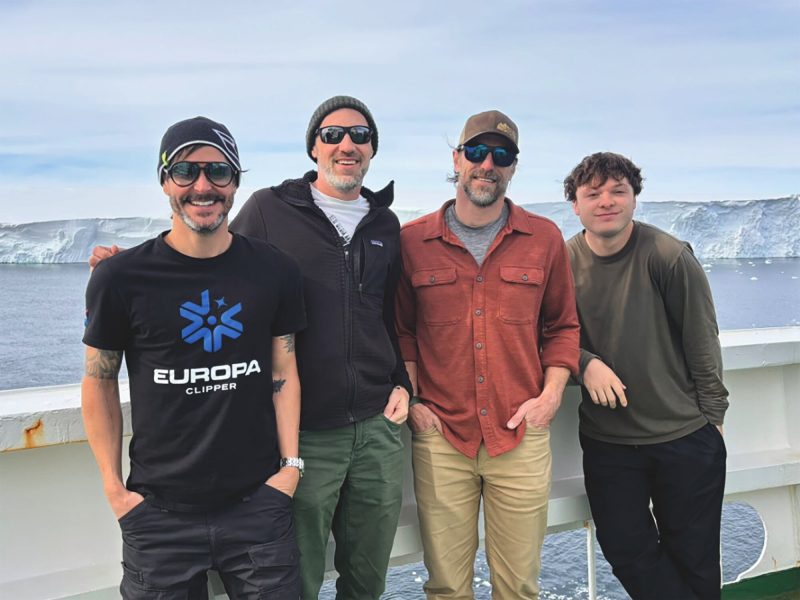
The aerial geophysics team arrives at the Thwaites Glacier Tongue, Jan. 8, 2026. Left to right: Jesse Houghton, Dillon Buhl, Christopher Pierce and Jason Bott. Photo: Unknown.
Thwaites Glacier Tongue, Jan. 9, 2026. Photo: Jesse Houghton, UTIG.
R/V Araon in the polynya near Thwaites Glacier. Photo: Dominic O’Rourke, HSI.
R/V Araon in sea ice in the Amundsen Sea near Thwaites Glacier, Jan. 13, 2026. Photo: Jesse Houghton, UTIG.
Installing the UTIG ice-penetrating radar system on an HSI helicopter aboard R/V Araon, Jan. 20, 2026. Photo: Jesse Houghton, UTIG.
UTIG Research Program Manager Jesse Houghton on the deck of R/V Araon at Pine Island Glacier, Jan. 15, 2026. Photo: Nevan Swanson, PBS.
HSI helicopter equipped with the UTIG ice-penetrating radar system in preparation for the first survey flight, Thwaites Glacier Tongue, Jan. 22, 2026. Photo: Jesse Houghton, UTIG.
Ice-penetrating radar data processing station aboard R/V Araon. Photo: Jesse Houghton, UTIG.
Jason Bott, left, and Jesse Houghton process ice-penetrating radar data aboard R/V Araon at Thwaites Glacier, Jan. 22, 2026. Photo: Jesse Houghton, UTIG.
HSI helicopter returns from ice-penetrating radar survey flight F03 over the eastern Thwaites Ice Shelf, Jan. 26, 2026. Photo: Jesse Houghton, UTIG.
Jesse Houghton disassembles radar antenna booms from the survey helicopter following completion of the aerial survey campaign at Thwaites Glacier, Jan. 31, 2026. Photo: Jason Bott.
An HSI helicopter departs R/V Araon for the final ice-penetrating radar survey flight, F06, over Haynes Glacier and Thwaites Glacier, Jan. 30, 2026. Christopher Pierce in foreground. Photo: Jesse Houghton, UTIG.