One Step Closer to Net-Zero Mining
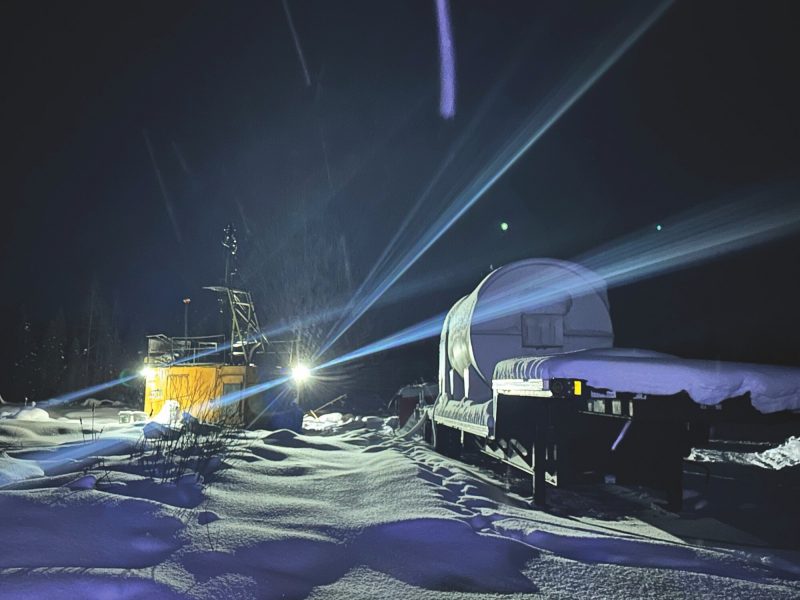
Research Associate Professor Estibalitz Ukar is leading a project that is advancing critical mineral mining and carbon storage, all in the same place.
In December 2025, she and collaborators at Canada Nickel, UT and partner universities marked a major milestone by injecting 12 tons of CO2 dissolved in water at a field test site at Canada Nickel’s Crawford Nickel Project, a site located in northern Ontario that’s home to the second-largest known nickel reserve in the world.
All data collected to date indicate that the field test was a success: All the CO2 remains dissolved at depth, with no surface leakage detected. The team has also detected the precipitation of new serpentine and low-temperature carbonates in core samples — promising results that suggest the desired geochemical reactions are occurring.
The nickel ore at the Crawford project is hosted in ultramafic rock, which readily reacts with the injected CO2 to form carbonate rocks in a matter of months. Turned into carbonate, the CO2 is kept out of the atmosphere for good. At the same time, the CO2 injection process introduces fractures into the ultramafic rock, which helps break it apart before mining even begins. This pre-fracturing is estimated to reduce energy costs associated with extracting and breaking up ore by at least 50%.
Ukar’s research on carbon-zero mining at the Crawford project is supported by a $5 million grant from the U.S. Department of Energy’s ARPA-E MINER program, which seeks to increase the domestic supply of critical minerals. Ukar is the project’s principal investigator. Collaborators include a team of more than 30 people from UT, Columbia University, Virginia Tech and Canada Nickel.
Ukar and her team are continuing to monitor the results and effects of CO2 injection at the Crawford project, including tracking seismicity and water chemistry to better understand subsurface fluid flow and the CO2 reaction processes.
Research by Estibalitz Ukar, Research Associate Professor
Bureau of Economic Geology