New Subsurface Database Could Be Boon for Natural Gas Industry
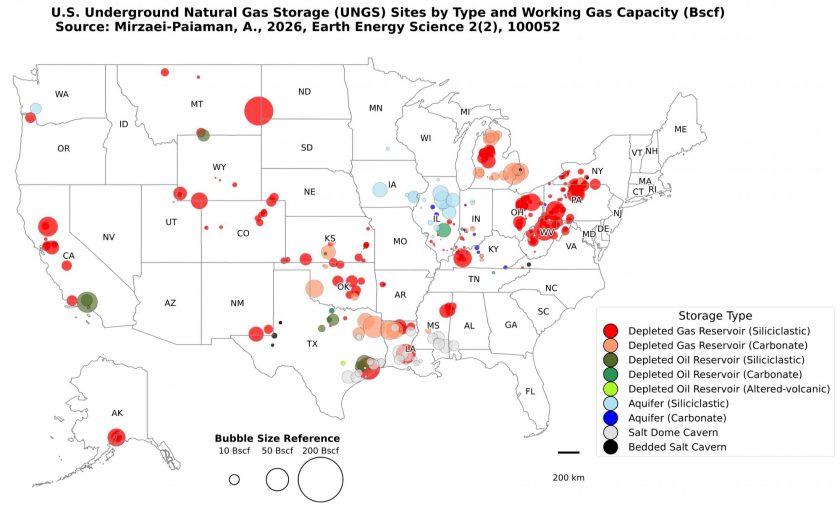
A new analysis of underground natural gas storage sites across the country can help guide future expansion of natural gas storage capacity, optimize existing storage facilities, and aid in developing the emerging hydrogen and carbon storage industries.
The study is the first to combine geological assessments, reservoir engineering data and operational data from the nationwide network of underground storage systems that store natural gas. The information can serve as a tool for companies looking to expand their natural gas storage systems, which is expected to be necessary in the coming years as demand and production of natural gas increase.
The new study builds on and significantly expands two existing databases: one maintained by the U.S. Energy Information Administration and the other by the U.S. Pipeline and Hazardous Materials Safety Administration. While these databases provide basic facility-level information, the researchers took the analysis a step further by compiling detailed geological, subsurface, and operational data for underground gas storage facilities across the United States. The new integrated database provides a far more comprehensive and valuable resource for gas storage engineering and enables analyses that were previously not possible using the publicly available datasets alone.
Beyond natural gas, the researchers said that the new database can be used to assess the storage of other gases as well. That includes hydrogen, a carbon-free fuel source, or CO2 emissions, which could be kept out of the atmosphere by being stored permanently underground.
Research by Abouzar Mirzaei Paiaman, research assistant professor
Bureau of Economic Geology
Research published June 2026 in Earth Energy Science