Ian Dalziel Retires
Celebrating a titan of the geosciences whose legacy is as grand as the supercontinents he studied
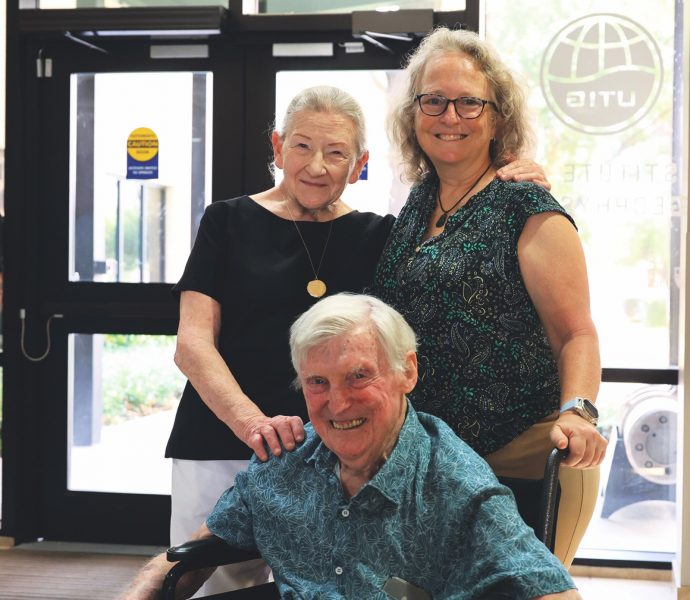
For the past few years, tucked away in a conference room on the third floor of the University of Texas Institute for Geophysics (UTIG) offices, a team of four enthusiastic geoscientists would start their day over coffee and cookies.
At the helm was Ian Dalziel, a world-renowned geologist and geophysicist, who chose this specific group of Jackson School past collaborators, students and friends to help him assess a new and radical hypothesis. Could the Ellsworth Mountains, the highest in Antarctica, be a fragment of Laurentia, the supercontinent that made up ancient North America that was once attached to the margin of present-day Texas? The team’s findings will enhance the understanding of how global geographic changes involving movement of tectonic plates— most notably, the separation of Laurentia from Antarctica— set the stage for the early Paleozoic radiation of multicellular life.
But its significance doesn’t lie only in the field of paleobiology and pre-Pangean continental theory: It’s also the final paper Dalziel will publish as an active professor and senior research scientist at UTIG.
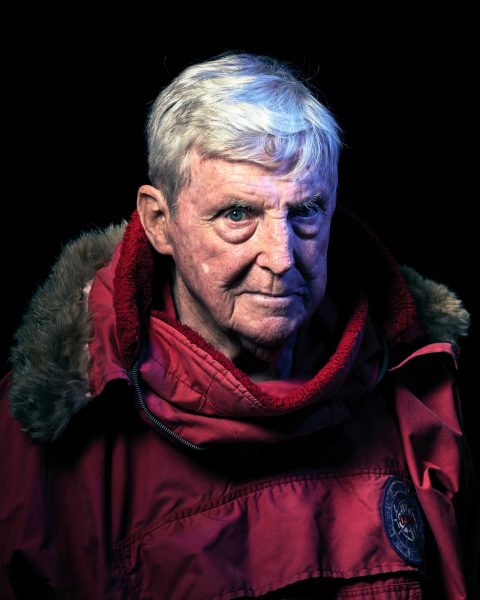
After 41 years with the Jackson School, Research Professor Ian W.D. Dalziel has retired.
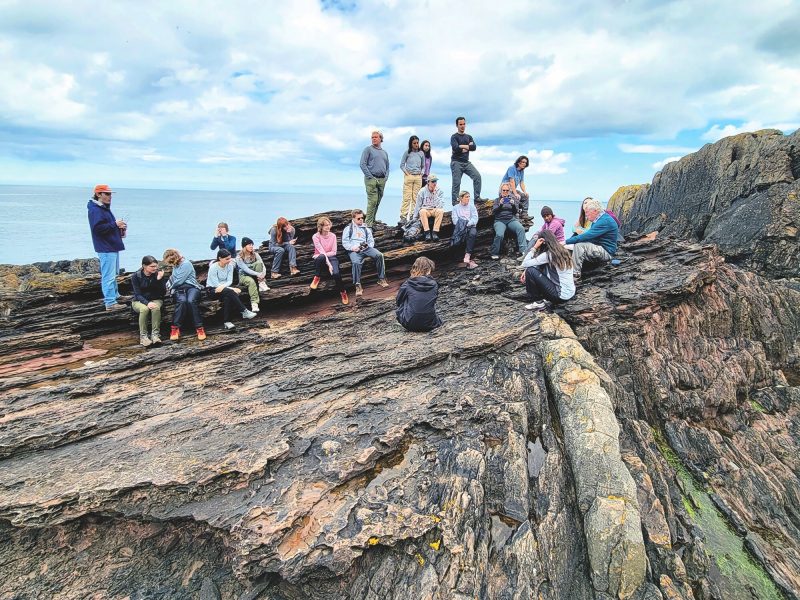
An intrepid polar explorer, his legacy lies in his pioneering studies of plate tectonics before Pangea and the theory of supercontinent cycles on Earth.
Born in Glasgow, Scotland, and brought up in the West Highlands, Dalziel was already making a name for himself by 1973 when he was elected to honorary membership of the Argentine Geological Association following his work on the remote island of South Georgia with his colleague, Robert H. Dott Jr. of the University of Wisconsin. After 18 years at Columbia University’s Lamont-Doherty Geological (now Earth) Observatory, including three spent as chairman of the Department of Geological Sciences, Dalziel was recruited to UTIG by former institute director Art Maxwell to promote research in the high southern latitudes.
He immediately went to work leading research cruises to the Scotia Arc region, conducting seismic work in interior Antarctica, and establishing a network of GPS receivers across West Antarctica that would tune the scientific community into the alarming rate in which the continent’s ice was melting and its impact on global sea level rise. He also became an important contributor to the institute’s decades-long PLATES project, which sought to model past and present continental and oceanic plate movement.
Always intent on bringing the Antarctic continent into global thinking in the Earth sciences, he persuaded the National Science Foundation to let him have the small Antarctic research vessel Duke for a monthlong cruise in the Scotia Arc region in 1989. He then persuaded 25 geologists from 22 countries to participate. Dalziel had a hunch that the experienced group might find clues to the paleogeography of the Earth before the Pangea supercontinent. Discussions aboard the Duke led to the Southwest U.S.–East Antarctic hypothesis that the Pacific margins of North America and East Antarctica-Australia were once juxtaposed. This kicked off a wave of research that opened the way to test hypotheses about pre-Pangea geography, supercontinental cycles, and their sway over global environments.
This expedition is just one example of his knack for bringing people and ideas together, which is where his brilliance truly lies, said longtime collaborator and friend Pat Dickerson, who, with 50 years of experience studying the tectonostratigraphy of West Texas mountains, served as a co-author on Dalziel’s last UTIG paper.
The two became acquainted in the 1970s. Dickerson was working for Exxon Research, and Dalziel had just left the then-Columbia University Lamont-Doherty Geological Observatory. They bonded over discussions about the Marathon orogeny, the mountain-building event that formed modern mountains in West Texas, and how it compared with Dalziel’s and others’ continental reconstructions during the Paleozoic. The conversation was the spark for decades of collaboration.
“He wants to facilitate people getting together, and he wants to hear what you have to say about your science,” Dickerson said.
In 1992, Dalziel received the Murchison Medal from the Geological Society of London, mainly for his work in the southern Andes and South Georgia. And in 2003 he was awarded the Clough Medal by the Edinburgh Geological Society for his contributions to Scottish geology. He was elected a fellow of the Royal Society of Edinburgh and awarded the honorary degree of Doctor of Science by the University of Edinburgh.
In 2021, Dalziel was awarded geology’s most prestigious career award, the Geological Society of America’s Penrose Medal. And in 2023, he was awarded the Polar Medal — the United Kingdom’s top award for polar exploration — for his contributions to Antarctic geology. The award was made by King Charles III and presented by his sister Anne, the Princess Royal, at Windsor Castle.
On paper, Dalziel’s numerous accolades may make him seem intimidating. But his reputation challenges any notion of unapproachability.
Just ask Joshua Malone, who spent the past six years under Dalziel’s wing during his master’s and doctoral studies at the Jackson School.
“He’s a very, very good champion for the people that he cares about,” said Malone. “[Dalziel] was one of the reasons I chose the Jackson School. It was an opportunity to work with a mind like his.”
It was during this time they spent working on Malone’s master’s thesis that the two would grow close.
Dalziel said he saw an impressive young geologist with a career trajectory he wanted to contribute to. He invited Malone to be a co-author and work on the final paper as the team’s detrital zircon expert, using the published data to perform a multicomponent analysis to better visualize the sources of the detrital crystals and their significance for continental breakup.
But even before their meeting, Dalziel had already made an impact on Malone’s life.
Malone comes from a family of geologists: His brother is a bedrock geologist at the Iowa Geological Survey, and his father is a distinguished professor of geology at Illinois State University. When his father leads trips in Baraboo, Wisconsin, he always has a copy of the Geological Society of America’s 1970 field guide “Geology of Baraboo District, Wisconsin.”
The guide, of course, was co-written by Dalziel during a brief stint as an assistant professor at the University of Wisconsin-Madison in the 1960s.
The two became well acquainted when Malone’s father visited Austin during his schooling, bringing two important figures in his life together.
Another one of Dalziel’s former students is Staci Loewy, a radiogenic isotope geochemist at the Jackson School. She earned her doctoral degree from the Department of Geological Sciences at UT in 2002 and provided the geochemical and geochronological expertise for Dalziel’s final UTIG paper. Like Malone, Dalziel was a mentor throughout her studies, albeit in a more worldly way.
“I remember being a third-year doctoral student, and Ian had invited me to Edinburgh to present on the Rodinia supercontinent,” Loewy recalls. “I was 36 hours late and as soon as I got to the conference, Ian says, ‘Oh good, you’re here — can you be on stage in 10 minutes?’”
Dalziel then went on to introduce her as the person who “destroyed his favorite hypothesis.”
During these early years, Loewy saw the way he worked and talked to people wherever they traveled, always looking for seemingly disparate pieces of evidence to tell the geological stories of the many shapes our world used to take. She said this is one of the best lessons he taught her.
Much like the pre-Pangean landmasses Dalziel spent his career understanding, Dickerson, Malone, Loewy, and Dalziel have split, at least when it comes to their morning meetings. But like West Texas and Antarctica, there always will be evidence of the time they spent together.
Dalziel said ee’s not done with research yet.He still plans to publish what he can well into his retirement.
“I don’t think I’ll be putting pen to paper as much as I used to, though. I think I’ve earned at least that,” Dalziel said. “But scientific curiosity may always pull me back into the fray!”