Arctic Soil Holds Just as Much Carbon as Permafrost Below
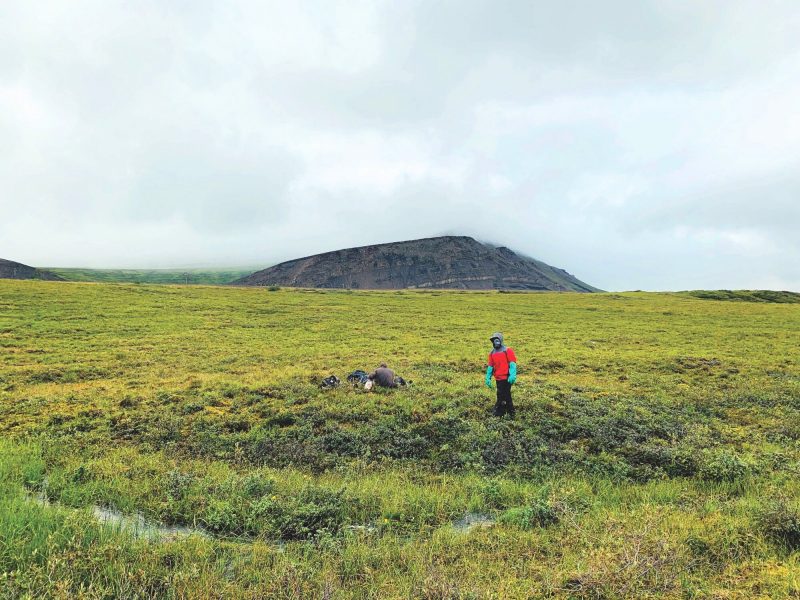
Carbon-rich permafrost is a potent source of greenhouse gases that can affect climate change as it thaws, but the active layer of soil that sits on top of permafrost could be an equally important contributor, according to new research.
Few studies have looked at how some properties of the active layer, like soil stratigraphy and overlying vegetation, relate to carbon and nitrogen mass storage estimates. This problem is compounded by the hyper-local nature of soil and limited field data, which prevents simple averaging from giving an accurate and unbiased picture.
For this work, researchers wanted to improve carbon estimates by taking statistically representative, on-the-ground measurements. They also measured nitrogen levels, which can affect surrounding water quality and ecosystem health.
After collecting over 200 samples from across the Arctic Foothills on the North Slope of Alaska over multiple seasons, researchers fully characterized the active layer carbon and nitrogen mass, incorporating Monte Carlo simulations to more accurately characterize soil properties.
Their results revealed that the range of total carbon and nitrogen is higher than previous estimates and is equal to or exceeds the amounts in the permafrost below.
Their findings suggest that this could also be the case in other parts of the world.
Researchers warn that if this soil is exposed to sudden fire or continued rising global temperatures, the gases could be expelled into the environment, contribute to climate change, and affect environmental quality.
Research by Sophy Yu Wu, Ph.D. 2023; Jingyi “Ann” Chen, associate professor; Mike O’Connor, Ph.D. 2019; Bayani Cardenas, professor
Cockrell School of Engineering; Department of Earth and Planetary Sciences
Research published July 2026 in Arctic Science